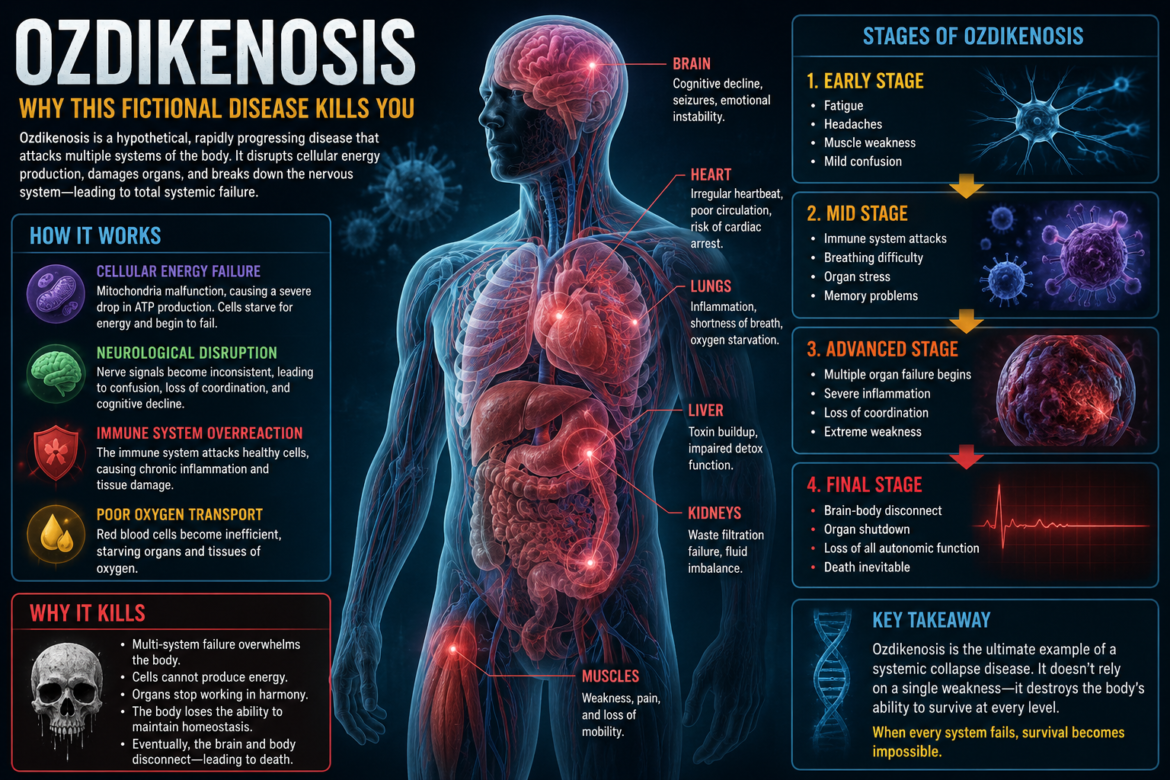
Ozdikenosis is a fictional and conceptual disease often used in speculative medical writing and creative world-building to explore how unknown biological mechanisms could potentially disrupt human life. While it does not exist in real-world medicine, examining its hypothetical progression helps illustrate how a disease can become fatal when it interferes with multiple essential body systems at once.
In most interpretations of ozdikenosis, the condition is described as a rapidly progressing systemic disorder that affects cellular energy production, neurological signaling, and organ coordination simultaneously. The reason ozdikenosis “kills” in fictional medical frameworks is not due to a single cause, but rather a cascading failure of biological functions.
This article explores the imagined pathology of ozdikenosis, how it spreads through the body, and why it is considered universally fatal in most fictional depictions.
The Origin Concept of Ozdikenosis
In speculative biology, ozdikenosis is often introduced as a mutation-based disorder triggered by an unknown environmental catalyst or dormant genetic instability. Some fictional theories suggest it begins at the cellular level, where mitochondria—the energy-producing structures inside cells—start functioning abnormally.
Others describe it as a prion-like condition, where misfolded proteins spread through tissues, corrupting normal biological processes. Regardless of the version, the defining characteristic remains the same: ozdikenosis disrupts the body’s ability to maintain internal balance (homeostasis).
Unlike common diseases that target a single organ or system, ozdikenosis is portrayed as a multi-system failure disorder. This is the key reason it is considered fatal.
Early Stage Progression – Subtle but Dangerous Changes
Cellular Energy Breakdown
In the earliest fictional stage, ozdikenosis affects ATP production—the energy currency of cells. As mitochondria begin to fail, the body experiences:
- Extreme fatigue
- Muscle weakness
- Slowed reflexes
- Reduced organ efficiency
At this stage, symptoms might appear harmless or similar to chronic fatigue disorders. However, beneath the surface, the body is already entering an energy crisis.
Neurological Disruption
Shortly after energy depletion begins, the nervous system becomes affected. Neurons depend heavily on energy to transmit signals. As ozdikenosis progresses, nerve communication becomes inconsistent.
This leads to:
- Confusion and memory lapses
- Mood instability
- Difficulty coordinating movement
- Sensory distortions
In fictional medical models, this is when patients begin to lose coherent control over bodily responses.
Mid-Stage Progression – Systemic Collapse Begins
At this stage, ozdikenosis is no longer localized. It spreads through multiple organ systems, creating a domino effect of failure.
Immune System Overreaction
One of the most dangerous aspects of ozdikenosis is how the immune system reacts. In many fictional descriptions, the immune system misidentifies damaged cells as foreign threats and begins attacking the body itself.
This leads to chronic inflammation, which causes:
- Swelling of vital organs
- Tissue degradation
- Fever spikes
- Autoimmune-like responses
Ironically, the body’s defense system becomes a major contributor to its own decline.
Blood and Oxygen Transport Failure
As the disease progresses, red blood cell efficiency declines. Oxygen transport becomes inconsistent, meaning tissues and organs begin to suffocate at a microscopic level.
Symptoms include:
- Dizziness
- Shortness of breath
- Cyanosis (bluish skin discoloration in fictional descriptions)
- Organ fatigue
This stage is often considered a turning point where reversal is no longer possible in fictional medical lore.
Advanced Stage Ozdikenosis – Multi-Organ Failure
Organ Synchronization Breakdown
In healthy physiology, organs work in a synchronized system. In ozdikenosis, this synchronization collapses entirely. The liver, kidneys, heart, and lungs begin operating independently without regulatory balance from the brain and endocrine system.
This results in:
- Kidney filtration failure
- Irregular heart rhythms
- Liver detoxification breakdown
- Fluid imbalance in tissues
At this point, the body is no longer functioning as a unified system.
Cellular Necrosis Spread
A defining feature of advanced ozdikenosis is widespread cellular necrosis—cells begin to die faster than they can be replaced. Unlike normal cell death, this process is uncontrolled and continuous.
This leads to:
- Tissue decay
- Loss of muscle structure
- Breakdown of internal organs
- Severe pain or neurological shutdown
The body becomes unable to repair itself, marking the beginning of irreversible decline.
Final Stage – Why Ozdikenosis Becomes Fatal
The reason ozdikenosis ultimately kills in fictional explanations is due to a phenomenon called total systemic collapse.
Loss of Homeostasis
Homeostasis is the body’s ability to maintain internal stability. In ozdikenosis, every major regulatory system fails simultaneously:
- Temperature regulation collapses
- Hormonal signaling becomes erratic
- Blood pressure becomes unstable
- Neural communication ceases to function properly
Without homeostasis, survival is biologically impossible.
Brain-Body Disconnect
One of the final stages involves a breakdown between the brain and the body. The brain may still attempt to send signals, but the body is no longer capable of responding effectively.
This creates:
- Loss of voluntary movement
- Cognitive disconnection
- Shutdown of autonomic functions (breathing, heartbeat regulation)
Eventually, even involuntary life-supporting functions fail.
Why Ozdikenosis Is Considered Universally Fatal in Fiction
Unlike many diseases that allow for adaptation or partial recovery, ozdikenosis is often written as universally fatal because it does not rely on a single failure point. Instead, it attacks multiple biological systems at once.
Key reasons for its fictional lethality:
- Multi-system targeting – It affects brain, blood, organs, and cells simultaneously.
- Self-amplifying damage – Immune response accelerates deterioration.
- Energy collapse – Cells cannot produce sufficient energy to survive.
- Irreversible progression – Damage accumulates faster than repair mechanisms can respond.
- Loss of regulatory control – The body loses coordination entirely.
Because of these combined effects, ozdikenosis is often depicted as a “perfect storm” disease in speculative biology.
Symbolic Interpretation of Ozdikenosis
Beyond its fictional medical description, ozdikenosis is sometimes used symbolically in storytelling. It can represent:
- The fragility of human biology
- The unpredictability of mutation
- The consequences of uncontrolled cellular damage
- The idea of systems collapsing under pressure
Writers often use such diseases to explore fear of the unknown or the limits of medical science.
FAQ
1. What is ozdikenosis?
Ozdikenosis is a fictional disease used in speculative or creative writing. It is typically described as a rapidly progressing condition that affects multiple body systems at once, including cells, organs, and the nervous system.
2. Is ozdikenosis a real medical condition?
No. Ozdikenosis does not exist in real-world medicine or scientific literature. It is purely a fictional concept used for storytelling, world-building, or hypothetical medical scenarios.
3. Why is ozdikenosis considered fatal in most descriptions?
In fictional explanations, ozdikenosis is fatal because it causes widespread system failure in the body. It disrupts energy production, damages organs, and breaks down nervous system communication, leading to total loss of biological function.
4. What are the supposed symptoms of ozdikenosis?
Commonly described fictional symptoms include severe fatigue, confusion, muscle weakness, organ dysfunction, breathing difficulties, and progressive neurological decline.
5. How does ozdikenosis spread in the body?
In most fictional models, it spreads at the cellular level, gradually affecting tissues, then organs, and eventually the entire body system, causing cascading failure.
Conclusion
Ozdikenosis kills in fictional frameworks not because of one specific defect, but because it represents a complete breakdown of biological order. Starting from cellular energy failure and progressing through immune dysfunction, oxygen deprivation, organ collapse, and neurological shutdown, the disease illustrates how interconnected human life systems truly are.
While entirely imaginary, the concept serves as a powerful reminder: when multiple survival systems fail together, recovery becomes impossible.
In storytelling and theoretical science fiction, ozdikenosis remains a striking example of how a single disorder—if capable of spreading across every level of biology—could inevitably lead to total systemic failure and death.