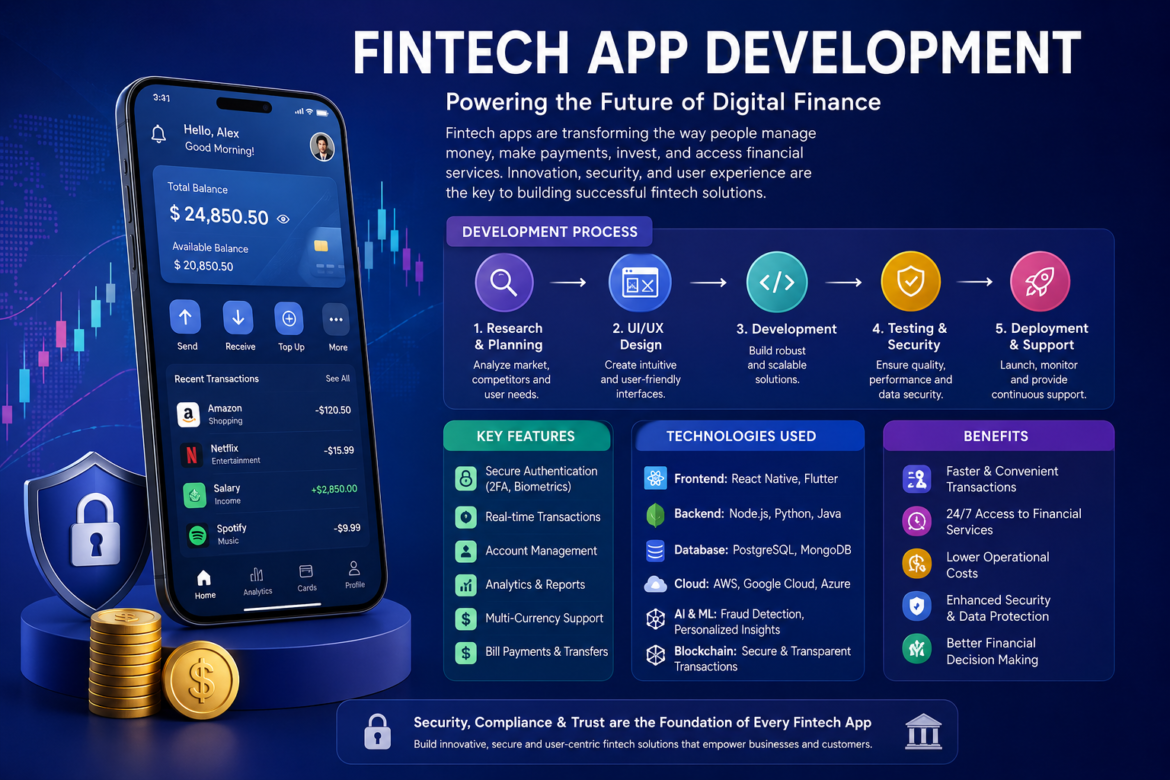
Fintech app development refers to the process of designing, building, and maintaining digital applications that provide financial services through technology. These apps are transforming how people manage money, make payments, invest, borrow, and interact with financial systems.
Over the past decade, fintech has moved from a niche innovation to a global industry standard. From mobile banking apps to digital wallets and investment platforms, fintech applications are now an essential part of everyday life. Businesses, startups, and even traditional banks are investing heavily in fintech solutions to stay competitive in a rapidly evolving digital economy.
The rise of smartphones, cloud computing, artificial intelligence, and blockchain technology has further accelerated fintech growth. Today, users expect fast, secure, and seamless financial experiences—and fintech apps are designed to meet those expectations.
What is Fintech App Development?
Fintech app development involves creating software solutions that provide financial services digitally. These applications may target individuals, businesses, or financial institutions.
Common types of fintech applications include:
- Mobile banking apps
- Digital wallets (e.g., payment apps)
- Investment and trading platforms
- Cryptocurrency exchanges
- Peer-to-peer lending apps
- Insurance technology (InsurTech) apps
- Personal finance management tools
Each of these applications requires strong security, real-time data processing, and smooth user experience.
Fintech development is not just about coding an app—it involves financial compliance, data protection, user trust, and integration with banking systems and APIs.
Key Features of a Fintech Application
A successful fintech app must offer features that ensure convenience, reliability, and security. Below are some of the essential features:
1. Secure Authentication
Security is the backbone of any fintech application. Features like biometric login (fingerprint or face recognition), two-factor authentication (2FA), and encrypted passwords are essential to protect user data.
2. Real-Time Transactions
Users expect instant money transfers, payment confirmations, and live updates on account activity. Real-time processing is a must-have feature.
3. User-Friendly Interface
A clean and intuitive UI ensures users can easily navigate the app, even if they are not tech-savvy.
4. Multi-Currency Support
Many fintech apps operate globally, so supporting multiple currencies and exchange rates is important.
5. Analytics and Reports
Personal finance tracking, spending insights, and investment analytics help users make informed financial decisions.
6. Integration with Banks and APIs
Fintech apps must integrate with banking systems, payment gateways, and third-party financial services.
Technologies Used in Fintech App Development
Fintech development relies on advanced technologies to ensure performance, scalability, and security.
Frontend Technologies
- React Native
- Flutter
- Swift (iOS)
- Kotlin (Android)
These technologies help build responsive and cross-platform mobile apps.
Backend Technologies
- Node.js
- Python (Django, Flask)
- Java (Spring Boot)
- Ruby on Rails
Backend systems handle data processing, authentication, and business logic.
Databases
- PostgreSQL
- MongoDB
- MySQL
- Firebase
These databases store sensitive financial data securely and efficiently.
Cloud Platforms
- AWS (Amazon Web Services)
- Microsoft Azure
- Google Cloud Platform
Cloud infrastructure ensures scalability and high availability.
Emerging Technologies
- Artificial Intelligence (AI) for fraud detection and financial predictions
- Blockchain for secure transactions
- Machine Learning for personalized financial insights
- Big Data analytics for customer behavior analysis
Steps in Fintech App Development Process
Developing a fintech app involves several structured stages:
1. Market Research and Planning
Understanding user needs, competitors, and regulatory requirements is the first step. This helps define the app’s purpose and features.
2. UI/UX Design
Designers create wireframes and prototypes to ensure a smooth user experience. The goal is to make financial operations simple and accessible.
3. Choosing Technology Stack
Selecting the right technologies is crucial for performance, scalability, and security.
4. App Development
Developers build frontend and backend systems, integrate APIs, and implement core functionalities.
5. Security Implementation
Security measures like encryption, firewalls, tokenization, and compliance with financial regulations are implemented.
6. Testing and Quality Assurance
The app is tested for bugs, performance issues, and security vulnerabilities. Testing ensures reliability before launch.
7. Deployment
Once testing is complete, the app is launched on platforms like Google Play Store and Apple App Store.
8. Maintenance and Updates
Continuous updates are required to improve performance, fix bugs, and add new features.
Challenges in Fintech App Development
Despite its growth, fintech development comes with several challenges:
1. Security Risks
Financial apps are prime targets for cyberattacks. Developers must constantly improve security systems.
2. Regulatory Compliance
Different countries have strict financial regulations. Ensuring compliance can be complex and time-consuming.
3. Scalability Issues
As user bases grow, apps must handle large volumes of transactions without performance issues.
4. Integration Complexity
Connecting with banks, payment systems, and third-party APIs can be technically challenging.
5. User Trust
Since fintech apps handle sensitive data, building trust through transparency and security is critical.
Benefits of Fintech Applications
Fintech apps provide numerous benefits to users and businesses:
- Faster and more convenient financial transactions
- Reduced dependency on physical banks
- 24/7 access to financial services
- Lower transaction costs
- Better financial planning tools
- Improved accessibility for unbanked populations
These advantages are driving the global adoption of fintech solutions.
Future of Fintech App Development
The future of fintech is highly promising. As technology continues to evolve, fintech apps will become even more intelligent, secure, and personalized.
Some expected future trends include:
- Increased use of AI-powered financial assistants
- Growth of decentralized finance (DeFi) platforms
- Expansion of blockchain-based payment systems
- More biometric and passwordless authentication methods
- Hyper-personalized financial recommendations
Fintech is also expected to play a major role in financial inclusion, especially in developing countries where traditional banking access is limited.
1: What is fintech app development?
Fintech app development is the process of creating digital applications that provide financial services such as banking, payments, investing, lending, and money management using modern technology like AI, cloud computing, and blockchain.
2: How much does it cost to develop a fintech app?
The cost of developing a fintech app varies based on features, complexity, and platform. A basic fintech app may cost around $20,000–$50,000, while advanced apps with AI, security layers, and integrations can exceed $100,000 or more.
3: How long does it take to build a fintech app?
On average, a fintech app takes 3 to 9 months to develop. Simple apps may take less time, while complex platforms like investment or banking apps require more time for development, testing, and compliance.
4: What are the main security features in fintech apps?
Fintech apps include multiple security layers such as:
- Two-factor authentication (2FA)
- Biometric login (fingerprint/face ID)
- End-to-end encryption
- Fraud detection systems
- Secure API integration
These features protect sensitive financial data and prevent unauthorized access.
5; What technologies are used in fintech app development?
Common technologies include:
- Frontend: React Native, Flutter
- Backend: Node.js, Python, Java
- Databases: PostgreSQL, MongoDB
- Cloud: AWS, Google Cloud, Azure
- Advanced tools: AI, blockchain, and machine learning
These technologies ensure scalability, speed, and security in financial applications.
Conclusion
Fintech app development is revolutionizing the financial industry by combining technology with financial services. It enables faster transactions, better user experiences, and more secure financial ecosystems.
However, building a successful fintech app requires careful planning, strong security measures, compliance with regulations, and continuous innovation.
As digital transformation accelerates, fintech apps will continue to shape the future of global finance, making financial services more accessible, efficient, and user-friendly than ever before.