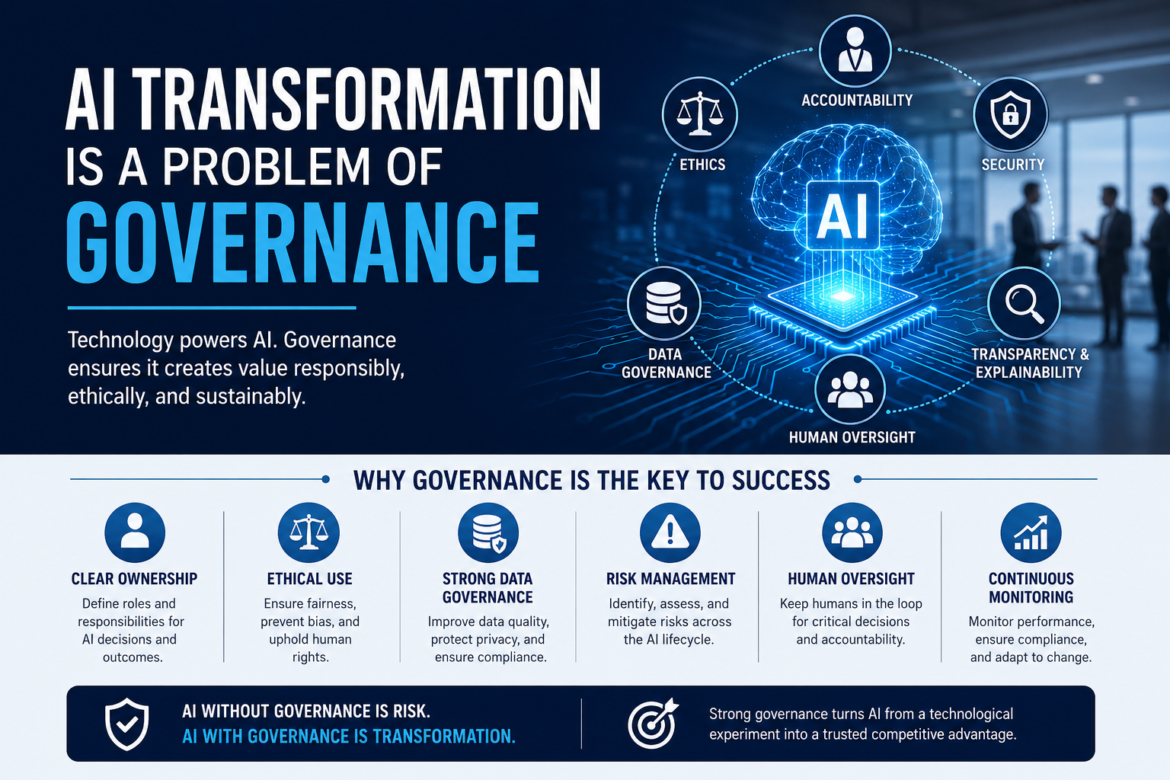
Artificial Intelligence (AI) has moved beyond being a futuristic concept and has become a central force reshaping industries, organizations, and societies. Businesses worldwide are integrating AI into operations, customer service, marketing, finance, healthcare, and decision-making processes. Many leaders discuss AI transformation as primarily a technological challenge involving algorithms, software systems, data platforms, and automation tools. However, the reality is more complex. AI transformation is not fundamentally a technology problem—it is a governance problem.
Organizations frequently fail in their AI initiatives not because the technology is weak but because leadership structures, decision-making processes, accountability systems, and ethical frameworks are inadequate. The implementation of AI requires organizations to rethink how they govern people, data, risks, and organizational values.
As AI continues influencing critical decisions and business operations, governance has become the determining factor that separates successful transformation from organizational confusion.
Understanding AI Transformation
AI transformation refers to the process through which organizations integrate artificial intelligence into their strategies, operations, and business models to create value and improve performance.
This transformation often includes:
- Automating business processes
- Improving customer experiences
- Enhancing decision-making
- Increasing operational efficiency
- Predicting market trends
- Creating new products and services
Many organizations initially believe AI transformation is mainly about selecting the right technologies or investing in advanced software platforms. Consequently, they spend heavily on infrastructure and tools while paying less attention to organizational structure and oversight.
This approach often creates significant problems.
Technology alone cannot guarantee success because AI operates within systems created and managed by humans.
Why Governance Matters More Than Technology
Technology is simply an instrument. Governance determines how that instrument is used.
Governance involves establishing rules, policies, accountability systems, leadership responsibilities, and decision-making processes that guide organizational actions.
Without governance, AI systems can create confusion rather than progress.
Consider several questions organizations must answer:
- Who owns AI decisions?
- Who is accountable when AI produces errors?
- How is data quality managed?
- What ethical standards guide AI use?
- How are risks monitored?
- Who ensures fairness and transparency?
If these questions remain unanswered, even sophisticated AI systems may create serious consequences.
AI transformation succeeds when governance provides clear direction.
The Governance Challenges Behind AI Transformation
Lack of Clear Ownership
One of the most common problems in organizations is uncertainty about ownership.
AI initiatives often involve multiple departments:
- Information technology
- Data science teams
- Human resources
- Legal departments
- Operations
- Executive leadership
When everyone participates, responsibility can become unclear.
For example, if an AI recruitment system unintentionally favors one demographic group over another, determining responsibility becomes difficult.
Is the problem caused by:
- The data science team?
- Human resources?
- Executive management?
- Software vendors?
Without a governance structure defining ownership and accountability, organizations struggle to resolve problems effectively.
Ethical Decision-Making Challenges
AI systems increasingly influence decisions affecting people’s lives.
Examples include:
- Loan approvals
- Medical recommendations
- employee recruitment
- Performance evaluations
- Insurance assessments
Algorithms may unintentionally reproduce existing biases present in historical data.
Organizations focusing solely on technical performance may overlook ethical concerns.
Governance establishes frameworks that answer important questions:
- Is the AI system fair?
- Is the process transparent?
- Can decisions be explained?
- Are human rights protected?
Without ethical governance, AI systems can damage trust and reputation.
Data Governance Problems
AI depends heavily on data.
The phrase “garbage in, garbage out” accurately reflects the reality of AI systems. Poor-quality data leads to poor outcomes.
Data governance involves:
- Data accuracy
- Data security
- Privacy protection
- Data ownership
- Access controls
- Compliance standards
Organizations frequently collect massive amounts of data without implementing effective governance structures.
As a result, AI systems may operate using outdated, incomplete, or biased information.
Technology cannot solve these problems independently.
Strong governance processes are necessary.
AI Risks Extend Beyond Technical Errors
Many organizations focus heavily on technical risks such as system failures or software bugs.
However, AI introduces broader organizational risks.
Reputational Risks
Customers and employees increasingly expect organizations to use AI responsibly.
A poorly governed AI system can quickly create public criticism.
Examples may include:
- Biased hiring algorithms
- Misleading recommendations
- Privacy violations
- Unfair customer treatment
Even when technical systems function correctly, negative public perception can damage brand trust.
Legal and Regulatory Risks
Governments worldwide are developing AI regulations and standards.
Organizations that fail to govern AI effectively may face:
- Financial penalties
- Legal action
- Compliance failures
- Regulatory restrictions
Regulations continue evolving, making governance even more critical.
Organizations require systems that continuously monitor compliance and adapt to changing rules.
Workforce Risks
AI transformation changes how people work.
Employees may worry about:
- Job security
- Changing responsibilities
- Skill requirements
- Workplace uncertainty
Technology implementation without proper workforce governance creates resistance and anxiety.
Leadership must guide employees through transformation with transparency and communication.
Leadership Is Central to AI Governance
AI transformation requires active leadership participation.
Some executives mistakenly assume AI is primarily an IT department issue.
This assumption creates major obstacles.
AI affects:
- Business strategy
- Organizational culture
- Customer relationships
- Risk management
- Human resources
- Financial planning
Therefore, leadership teams must actively shape governance structures.
Effective leaders ask questions such as:
What problems are we solving?
Organizations sometimes adopt AI simply because competitors are doing so.
Successful transformation begins with clearly identifying business goals.
How will success be measured?
Governance establishes measurable outcomes.
Possible metrics include:
- Customer satisfaction
- Productivity improvements
- Revenue growth
- Risk reduction
- Employee engagement
How do we maintain accountability?
Leadership must define roles and responsibilities clearly.
Without accountability, AI projects often lose direction.
Building an Effective AI Governance Framework
Organizations seeking successful AI transformation should establish governance systems that include several key elements.
Establish Clear Policies
Policies define acceptable AI practices and provide organizational guidance.
Policies should address:
- Ethical principles
- Data use
- Privacy standards
- Risk management
- Human oversight
Create Cross-Functional Teams
AI impacts multiple areas of business.
Effective governance includes collaboration among:
- Technology specialists
- Legal experts
- Business leaders
- Human resources professionals
- Compliance teams
Cross-functional perspectives reduce blind spots.
Ensure Human Oversight
AI should support human decision-making rather than completely replace it.
Human oversight remains essential for:
- Reviewing sensitive decisions
- Identifying errors
- Managing exceptions
- Maintaining accountability
Organizations should avoid creating systems where humans simply accept algorithmic outputs without question.
Continuously Monitor Performance
AI systems evolve over time.
Changes in customer behavior, market conditions, and data patterns can affect outcomes.
Governance should include ongoing monitoring processes to ensure:
- Accuracy
- Fairness
- Security
- Compliance
Continuous evaluation helps prevent long-term issues.
The Future of AI Transformation Depends on Governance
The future of AI will involve increasingly powerful systems capable of performing complex tasks and influencing major decisions.
Organizations may possess the most advanced technology available, but technology alone does not guarantee successful transformation.
History repeatedly demonstrates that innovation without governance can create instability.
AI transformation is ultimately a leadership challenge.
The organizations that succeed will not necessarily be those with the largest AI budgets or the most advanced software. Instead, successful organizations will be those that create strong governance systems capable of balancing innovation with responsibility.
Conclusion
AI transformation is often described as a technological revolution, but its greatest challenge lies elsewhere. The central issue is governance.
Technology provides capability, while governance provides direction. AI systems require clear accountability, ethical standards, leadership oversight, data management, and risk control structures. Without these foundations, organizations may experience confusion, bias, legal problems, and declining trust.
Businesses that recognize governance as the core of AI transformation position themselves for long-term success. As artificial intelligence continues reshaping industries, the critical question is no longer whether organizations will adopt AI.